Your CGPA was perfect. You worked on your Statement of Purpose for weeks. Your transcripts are spotless . But most students totally ignore the one document that might quietly destroy an otherwise outstanding scholarship application.
That document is the scholarship recommendation letter, also referred to as the reference letter or Letter of Recommendation (LOR).
A transcript might be used by a scholarship committee to view your grades. They are unable to read your ability to lead a team when things go wrong, think under pressure, or possess the character necessary to represent their program internationally. The only document that can tell them clearly that from a perspective of someone who personally observed you, is a powerful LOR.
This comprehensive guide will teach you everything you need to know to write a strong recommendation letter for a scholarship. It includes who to ask, when to ask, how to write the request email, what a strong LOR should contain, common mistakes to avoid, and a ready-to-use sample letter created for Pakistani students applying to local and international scholarships in 2026.
What Is a Recommendation Letter for Scholarship?
A scholarship recommendation letter, also known as a letter of recommendation (LOR), reference letter, or letter of support, is a formal document written by an academic or professional colleague of yours. They attest to your qualifications, character, and potential in this letter, which explains to the scholarship committee why you should be chosen.
The LOR has third-party trust unlike your own writings and documentation. It is someone in a position of authority who tells the committee how good you are. using concrete instances and precise proof.
📌 Key Difference
A transcript shows what you achieved. A recommendation letter explains how you achieved it, who you are as a person, and why you will succeed where others might not.
Why Your LOR Can Make or Break Your Application
Scholarship panels examine hundreds of applications from students with essentially identical academic records, particularly for prestigious programs like Fulbright, Chevening, and DAAD. Nearly all applicants will have a polished SOP, high IELTS scores, and a solid GPA. The level of quality of recommendation letters is frequently what really sets finalists compared to the others.
A typical LOR that basically states that “this student is hardworking and dedicated” is negative to a successful application. It helps the committee know that even your referee was unable to find anything noteworthy or unique to say about you. However, an average application might be pushed to the shortlist with a letter full of specific examples, rankings, project results, and genuine personal testimonials.
⚠️ Important
Even a single weak or vague recommendation letter can cost you a scholarship — regardless of how strong your other documents are. Never treat your LOR as an afterthought.
Which Scholarships Require a Recommendation Letter?
Almost every major scholarship for Pakistani students . Both local and international requires at least one LOR. Here is a quick overview:
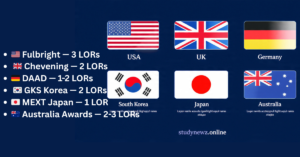
- Fulbright Scholarship (USA) : 3 recommendation letters required
- Chevening Scholarship (UK): 2 professional references
- DAAD Scholarship (Germany): 1 to 2 academic LORs
- Global Korea Scholarship (GKS): 2 academic recommendation letters
- HEC Need-Based / PhD Scholarships (Pakistan): 1 to 2 letters from the collage or professor
- MEXT Scholarship (Japan): 1 letter from the college or principal
- Commonwealth Scholarship (UK): 3 references (academic + character)
- Erasmus Mundus (EU): 2 academic recommendation letters
- Australia Awards Scholarship: Professional references strongly preferred
- Turkey Burslari (Türkiye Scholarships): Academic LOR required
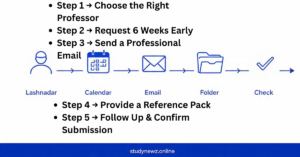
Step 1 — Choose the Right Person to Write Your LOR
In the entire LOR process, this is the most crucial choice. Selecting the incorrect individual can result in a poor letter that harms your application, even if they are well-respected.
For Academic LORs:
- A lecturer who instructed you directly, particularly in courses relevant to the field of study you have selected
- Your thesis advisor or research supervisor
- A project mentor or lab instructor who has closely observed your work
- A department head only if they are connected with you directly, not merely by name
For Professional LORs (especially for Chevening and Australia Awards):
- Your most recent or present line manager or employer
- An internship manager that directly oversaw your work
- The head of an NGO or organization that offered your support
✅ Best Choice
The ideal recommender is a professor who taught you across multiple courses, supervised your research or final year project, and has seen you perform under real academic pressure. They will have the most to say about you specifically and authentically.
❌ Avoid These Recommenders
Do not approach a professor who taught you in a single large lecture and barely knows your name. Their letter will be generic, and scholarship committees identify generic letters immediately. A vague letter from a famous professor is far worse than a specific, evidence-based letter from a lesser-known one.
Step 2 — When to Request a Recommendation Letter
Timing is one of the most overlooked aspects of the LOR process. Professors are busy people. If you approach them too late, you almost certainly will receive a rush, poorly written letter and a respectful rejection.
Generally speaking you should submit your LOR at least four to six weeks prior to the scholarship deadline. Six to eight weeks is highly suggested for large overseas scholarships.
| Scholarship Type | Request LOR How Early |
| Fully Funded International (Fulbright, Chevening, DAAD) | 6 to 8 weeks before deadline |
| HEC or Pakistan Government Scholarships | 3 to 4 weeks before deadline |
| University-Level or Departmental Scholarships | 2 to 3 weeks before deadline |
| Any scholarship requiring hard copy / sealed letter | 8 weeks minimum (postal time included) |
✅ Pro Tip
Even before you begin creating your SOP, start choosing your recommenders as soon as you decide to apply for a scholarship. Professors have more time to compose a well-considered, comprehensive letter the earlier you approach them.
Step 3 — How to Request Your LOR (With Email Template)
Your request email should be professional, clear, and respectful. Briefly explain which scholarship you are applying for. And why you are approaching this particular professor, what you need from them, and by when. Never make the professor feel pressured.
📧 Request Email Template — Copy, Personalise, and Send
Subject: Request for Letter of Recommendation — [Scholarship Name] — [Your Full Name]
Respected [Professor/Dr./Sir/Ma’am Name],
I hope this message finds you well. My name is [Your Name], a [Year] student of [Department/Program] at [University Name].
I am writing to respectfully request a letter of recommendation in support of my application for the [Scholarship Name]. The application deadline is [Date], and the letter would ideally be needed by [Date — at least 1 week before deadline].
Having studied under your guidance in [Course Name / Lab / Research Project], I believe you are well-placed to speak to my academic strengths and potential. During [your course / our project], I [specific achievement — e.g., “ranked among the top 5 students in the class” / “completed a research project on X which you graded as Outstanding”].
To make the process as easy as possible for you, I will provide a complete reference pack including:
- My updated CV
- My Statement of Purpose (SOP) draft
- Scholarship guidelines and requirements
- A brief document highlighting key points from our work together
I would be deeply honoured by your support. Please let me know if you are available for a brief meeting to discuss this, or if you have any questions.
Thank you sincerely for your time and consideration.
Warm regards,
- [Your Full Name]
- [Roll Number / Student ID]
- [Department, University]
- [Phone Number]
Step 4 — Create a Pack of References for Your Recommender
Your work is just getting started after your professor agrees to write the letter. How well you brief your recommender has a direct impact on the quality of your LOR. The greatest way to guarantee a good letter is to include a well-organized reference bundle.
Included in your reference bundle should be:
- 📄 Your Updated CV: A clean, update CV that is related to the scholarship
- 📝 Draft or Final SOP: so the professor’s letter is in in accordance with your objectives
- 📋 Scholarship Overview Sheet: Describe the scholarship, its worth, and the selection process
- 🎯 Key Achievements: Note a brief, bullet-point summary of your accomplishments while working under their guidance (5 to 8 points)
- 📅 Clear Deadline: the date by which the letter must be submitted
- 🔗 Submission Instructions: whether it must be sent via email, uploaded to a portal, or sent in a sealed, signed envelope
💡 The Key Achievements Note
This is the most powerful thing in your reference pack. Write 5 to 8 specific points about your performance under that professor’s supervision. like your grade or rank, a project you completed, a problem you solved and a skill you demonstrated. This gives the professor the raw material to write something specific and compelling rather than relying on vague memories.
Step 5 — What Must a Strong Recommendation Letter Include?
These are the essential components of a successful scholarship recommendation letter. whether your professor demands a draft (which is more frequent than most students realize) or you just want to know what to look for in a final letter before submission.
1. Official Letterhead
The recommender’s name, title, department, institution, and contact details must all be prominently shown in the letter, which must be printed on the official letterhead of their organization.
2. Strong Opening Paragraph
The introduction ought to establish:
- The identity and position of the recommender
- How long have they known you, and how do they relate to you?
- The scholarship’s name that they are suggesting you for
- A powerful, clear declaration of confidence from the opening line
3. Body — Specific Evidence and Achievements (Most Critical Part)
- The majority of Pakistani students’ letters fall fail in this category. Adjectives like “hardworking” or “intelligent” must not accurately describe the body. Scholarship committees have seen every compliment in the book after reading thousands of letters. They are looking for evidence.
- Your percentage or academic standing in the class (“ranked 3rd out of 78 students”)
- A particular assignment, research paper, or project with the result
- A real-life situation in which you showed creativity, leadership, or problem-solving skills
- Competitive comparison (“among the most capable students I have taught in 15 years”)
- Any honors, prizes, or awards that the instructor is aware of
4. Character and Soft Skills
Beyond academics, the letter should highlight your character, including your work ethic, integrity, capacity for teamwork, communication skills, curiosity, and resilience. These attributes are particularly important for scholarships that seek out future leaders.
5. Scholarship Alignment
The best letters directly link your profile to the scholarship’s objectives. A statement such as “I believe [Name]’s research interests align perfectly with the mission of the Fulbright Program” demonstrates to the committee that the recommender is aware of the scholarship and truly thinks you are the best candidate.
6. A Clear and Absolute Closing Declaration
There must be no room for doubt in the conclusion. Words like:
- “I recommend [Name] without any reservation.
- “I wholeheartedly support this application.
- “I am confident that [Name] will excel in this program.”
These are far stronger than a neutral “I hope you will consider this application favourably.”
7. Signature, Designation, and Contact Information
The letter needs to be signed, either digitally or with wet ink. The professor’s official email address and phone number must appear so the committee can verify the letter if needed.
📏 Ideal Length
A strong recommendation letter should fill one full page. Around three hundred to five hundred words. Too short and it looks like your referee had nothing to say. Three pages and it loses its punch. One tight well-written page is what works.
Sample Recommendation Letter for Scholarship
Below is a complete sample written from a professor’s perspective. Use it as a reference when briefing your recommender and preparing a draft.
[University/Organization Letterhead]
Department of [Subject Name]
[City] Pakistan
Date: [DD Month YYYY]
To the Scholarship Selection Committee
[Scholarship Name]
- I recommend Mr. / Ms. [Student Full Name] for the [Scholarship Name] with genuine enthusiasm and without any reservation. I have known [him/her] for [X] years as [his/her] professor of [Course Name] and as the supervisor of [his/her] final year research project at [University Name]. [He/She] is exactly the kind of candidate this scholarship is designed for.
- In my [Course Name] class of [X] students [he/she] ranked within the top 5 percent. That result did not come from memorising content. It came from actually understanding it and knowing how to use it. [His/Her] research project on [Project Title] was one of the most rigorous pieces of student work I have seen in over a decade. When the initial results did not go as expected [he/she] reworked the methodology and delivered conclusions that were credible and practically useful.
- What sets [Student Name] apart is not just the grades. During a group project the team hit a serious problem two weeks before the deadline. [He/She] stepped up. Took on more work. Reorganised the approach. Got it done on time and to a high standard. That kind of leadership and accountability is rare. I do not see it every year.
- [His/Her] goal to pursue [field of study / career goal] through the [Scholarship Name] makes complete sense given [his/her] academic path and professional interests. [He/She] will contribute to this program. Not just benefit from it.
- Please feel free to contact me at [email address] or [phone number] if you need anything further.
Sincerely
- [Professor Full Name]
- [Designation] e.g. Associate Professor / Head of Department
- Department of [Subject] [University Name]
- [City] Pakistan
- Email: [official university email]
- Phone: +92-[XXX]-[XXXXXXX]
How to Submit Your LOR
Once your professor finishes the letter find out how to submit it. Portal upload sealed envelope or direct email. Keep a copy for yourself. If there is an online portal send your professor the link and the deadline. Then follow up to confirm it went through.
Common Mistakes Pakistani Students Make With Their LOR
Steer clear of these mistakes, which are considerably more frequent than you might imagine and cost you actual scholarship opportunities:
- Asking for the letter too late: Approaching a professor seven or ten days prior to the due date demands a quick and generic letter.
- Selecting the incorrect recommender: A junior professor who directly oversaw your project is a better option than a senior one who hardly knows you.
- Giving no context or materials: Saying “I need a LOR” without supplying your resume, SOP, or any other references makes it difficult for the professor to write anything particular.
- Accepting a generic letter without reviewing it: Your application will suffer more than benefit if the letter lacks specific examples or rankings.
- Using the same LOR for each grant: Chevening looks for leadership, whereas Fulbright looks for research potential. These various priorities should be reflected in your letters.
- Forgetting to follow up: Professors are truly busy therefore they often forget to follow up. A courteous reminder is responsible, not rude.
- Not verifying submission: Before completing your application checklist, make sure the professor has sent the letter.
- Not reviewing the format requirements: Some scholarships need letters to be submitted via a portal, while others require letters to be sent in a sealed envelope. Before asking your lecturer to write, make sure of this.
How to Follow Up Politely Without Being Pushy
One week of silence after your request and it is time to follow up. Keep it short. Keep it warm.
📧 Follow-Up Email Template
Subject: Gentle Follow-Up — LOR Request for [Scholarship Name] — [Your Name]
Respected [Name]
- I hope you are well. I am following up on my earlier email from [Date] about a letter of recommendation for the [Scholarship Name].
- The deadline is [Date]. Please let me know if you need anything from my side. I am happy to send whatever helps.
Thank you so much.
- Warm regards
- [Your Name]
✅ Tip
If the deadline is very close (less than 5 days away) and you still have not received confirmation. It is appropriate to follow up by phone or WhatsApp as long as you have that level of communication with the professor. Always remain respectful.
Scholarship-Wise LOR Requirements — Quick Reference (2026)
| Scholarship | No. of LORs | Who Should Write It | Submission Format | Deadline Lead Time |
| Fulbright (USA) | 3 | Academic + Professional | Online Portal | 6–8 weeks |
| Chevening (UK) | 2 | Professional preferred | Online Form | 6 weeks |
| DAAD (Germany) | 1–2 | Academic (Professor) | Signed PDF / post | 6 weeks |
| GKS Korea | 2 | Academic | Official printed form | 4–6 weeks |
| Commonwealth (UK) | 3 | Academic + Character ref | Online Portal | 6 weeks |
| MEXT (Japan) | 1 | Dean / Principal | MEXT official form | 4 weeks |
| HEC (Pakistan) | 1–2 | Dean / Professor | Hard copy / sealed | 3–4 weeks |
| Erasmus Mundus (EU) | 2 | Academic | Varies by consortium | 6 weeks |
| Australia Awards | 2–3 | Professional preferred | Online Portal | 6 weeks |
| Türkiye Burslari | 1 | Academic | Online system | 3–4 weeks |
FAQs
Q: Can I write my own LOR draft and ask the professor to sign it?
A: Yes. Many professors in Pakistan actually prefer this. Just make sure they read it properly make their own changes and sign off on it in their own voice. It has to sound like them. Not you.
Q: What if the professor who knows me best has left the university?
A: A former professor can still write the letter. They should sign with their current designation and add their current contact details. Some scholarships want an active institutional email so check the requirements first.
Q: Can I use the same recommendation letter for multiple scholarships?
A: Not really. Fulbright is looking for research potential. Chevening wants leadership. At least change the scholarship name and tailor one paragraph. A fully generic letter sent everywhere will read like one.
Q: Should the CGPA be mentioned in the recommendation letter?
A: If your CGPA is strong then yes. If it is average then skip it. The letter should focus on your project work your growth and the qualities your transcript does not show.
Q: Is an employer’s LOR acceptable for academic scholarships?
A: For Fulbright DAAD and GKS you still need at least one or two academic referees. An employer letter can support your application but it cannot replace the academic one. For Chevening and Australia Awards, professional references are actually preferred.
Q: How long should a scholarship recommendation letter be?
A: One page. 300 to 500 words. Short looks rushed. Three pages loses the reader. One tight page hits the mark.
Conclusion — Your Recommendation Letter for Scholarship Is an Investment Not a Formality
This is not a document you hand off and forget about. It takes real planning the right recommender and proper preparation of everything you give them. Get that right and it becomes one of the strongest parts of your entire application. Most students who win Fulbright, Chevening and DAAD have similar GPAs to the students who do not. What they have that others do not is a letter that makes the committee feel like they already know the applicant. Specific. Real. Convincing.
Start early. Pick the right person. Brief them properly. Follow up. Four things. That is it. Your recommendation letter is not just another document in the file. It is the only part of your application written by someone other than you. Make sure it counts.
Never send your application without making sure every letter is as strong as everything else you have submitted.
About the Author
StudyNewz Team is a dedicated group of education consultants and scholarship researchers based in Pakistan. We help Pakistani students find understand and successfully apply for local and international scholarships from HEC to Fulbright.
Read more related latest scholarship: https://studynewz.online/hec-talent-hunt/