
You have good grades. Your test results have been completed. The paperwork is prepared. when you start writing your Statement of Purpose on a blank paper and your thoughts are totally empty.
This is how the majority of Pakistani students feel. Not because they are at a loss for words. because they were never taught the proper manner to say it.
The SOP for scholarship is the only section of your application where you address the committee personally. No figures. Not a single certificate. Just your narrative your objectives and your motivations. An average application will get to the top of the pile if it is written effectively. Even a 3.9 CGPA won’t save you if you write it poorly.
This guide covers everything. What a Statement of Purpose actually is. What committees want to read. How to write every single paragraph. What mistakes Pakistani students repeat year after year. And a complete sample SOP for scholarship you can use as a reference right now.
What Is an SOP for Scholarship?
A written document that you include with your scholarship application is called a Statement of Purpose (SOP) and sometimes referred to as a personal statement, motivation letter, or SOP. In it you tell the committee who you are why you want to study this specific field why you need this particular scholarship and what you plan to do after.
It is not a summary of your CV. Your resume is already with the committee. The SOP provides them with what the CV does not your direction your story and your way of thinking.
📌 Key Difference
Your score is displayed on your transcript. Your SOP for scholarship outlines your next steps and the reasons behind your decision. Both are necessary for a scholarship committee. They won’t be able to fill the gap left by one without the other.
Why Your SOP Can Win or Destroy Your Application
Imagine the situation facing the committee. Five hundred applications from students with similar backgrounds, test scores, and grades are being studied. What distinguishes one?
The answer is the just SOP. Nearly all the time.
A weak SOP says as follows: “I have always been passionate about education and I want to use this scholarship to further my studies and serve Pakistan.”
That is what every single candidate writes. It doesn’t say anything particular. It leaves committee members with nothing to remember you by.
Strong SOPs read entirely differently. It has a certain opening that causes the reader to pause. A real academic story. A clear reason for choosing this scholarship. objectives that are practical rather than decorative. And a sincere justification of why you in particular, are the ideal candidate.
⚠️ Warning
Thousands of SOPs have been read by scholarship committees. In the first two lines they identify an opinion that is confusing or duplicated. They move on once their interest decreases. There is no second chance for your application.
Which Scholarships Require an SOP?
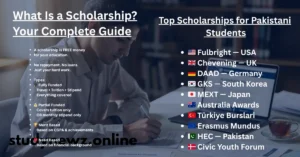
Almost every major scholarship for Pakistani students requires some version of a personal statement. The name changes but the purpose is the same.
| Scholarship | Document Name | Approx. Word Limit |
| Fulbright Scholarship (USA) | Personal Statement + Study Objective | 500 + 500 words |
| Chevening Scholarship (UK) | Four separate essays | 500 words each |
| DAAD Scholarship (Germany) | Motivation Letter | 1 to 2 pages |
| Global Korea Scholarship (GKS) | Study Plan | Varies |
| HEC Scholarships (Pakistan) | Personal Statement | 500 to 800 words |
| MEXT Scholarship (Japan) | Research Plan | 2 pages |
| Commonwealth Scholarship (UK) | Personal Statement | 500 words |
| GREAT Scholarships (UK) | Personal Statement | 500 words |
| SBW Berlin Scholarship (Germany) | Motivation Letter | 1 page |
| Australia Awards | Personal Statement | Varies |
| Türkiye Burslari | Motivation Letter | Varies |
| Civic Youth Forum (Denmark) | Motivation Letter | 300 to 500 words |
What Scholarship Committees Actually Want to Read
Before writing a single word understand what the reader is looking for. They are not looking for the most dramatic life story. They are not looking for the highest CGPA. They are trying to answer four questions about you.
The Four Questions Every SOP Must Answer
- Who are you and where did you come from academically?
- Why this specific field of study?
- Why this specific scholarship and institution?
- What will you do with this opportunity when it is over?
Every paragraph in your SOP should answer at least one of these questions. If a sentence does not answer any of them cut it. It is wasting space that belongs to your story.
✅ Simple Test
After writing each paragraph ask yourself which of the four questions does this answer? If you cannot answer that your paragraph does not belong in the SOP.
How Long Should an SOP Be?
This depends on the scholarship. Always check the specific guidelines first. But across most programs the following applies.
| Application Type | Recommended Length |
| Masters scholarships — general | 500 to 800 words |
| PhD or research-based programs | 1000 to 1200 words |
| Short motivation letters (Civic Youth Forum etc.) | 300 to 500 words |
| Chevening essays | 500 words per essay |
Never exceed the word limit. It tells the committee you cannot follow instructions. Never fall significantly short either. It tells them you had nothing to say.
What to Do Before You Write a Single Word
Most students open a blank page and start typing. That is why most SOPs are weak. Do this first instead.
Step 1: Answer These Questions on Paper
- What specific moment or experience made me choose this field?
- What is the most impressive or relevant thing I did academically?
- What work or research experience do I have that is relevant?
- What specifically do I want to study at this level and why?
- What is the particular purpose or value of this scholarship?
- What will I do in Pakistan after completing my degree?
Step 2: Do Your Homework on the Scholarship
Visit the official webpage for the scholarship. Recognise their values. Fulbright focuses on leadership and intercultural communication. Chevening wants professionals with influence potential. DAAD favours outstanding research programs. Your SOP must speak their language not just yours.
Step 3: Read Three to Five Strong Sample SOPs
not to copy. for understanding tone structure and the differences between specific and generic appearance. Reading examples helps you develop the ability to recognize the significant difference.
📚 Related Reading
Your SOP is only one part of a strong scholarship application. You also need a powerful recommendation letter. Read our complete guide here:
→ How to Get a Recommendation Letter for Scholarship in 2026 — Complete Guide
How to Structure Your SOP — Paragraph by Paragraph
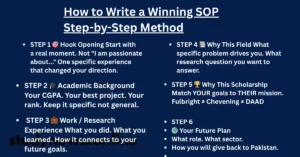
A strong SOP has a clear shape. Six paragraphs each doing a specific job. Here is exactly what goes in each one.
Paragraph 1: The Opening Hook
This is the most important paragraph in your entire SOP. It decides whether the reader keeps reading or mentally moves on while their eyes are still on the page.
Do not start with “I am writing to apply for…” or “Since childhood I have been passionate about…” Every application starts that way. It has been seen a thousand times by the reader.
Start with something real. A specific moment. A problem you encountered. A question that has driven your choices. You made this decision because of one sincere factor.
Weak opening:
“I have always been passionate about development economics and I have always wanted to study abroad to fulfil my dreams.”
Strong opening:
“I witnessed flood relief in my home area in 2022, but it never got to the targeted recipients. At the time, I was a third-year student of economics. That single experience changed what I wanted to do with my degree.”
One is forgotten before the reader finishes it. The other makes them want to know what happened next.
Paragraph 2: Your Academic Background
Now tell them where you studied what you studied and what you achieved. Hold it tight. Don’t include every course you’ve ever taken. Select two or three educational experiences that directly relate to your desired course of study.
If your CGPA or class rank is high, mention it. If it is pertinent, mention a particular research article or final year project. The term “specific” is crucial. Not just “I performed well in my studies” but rather “I ranked 4th in a class of 67 students and completed a research project on water access disparities in southern Punjab.”
Paragraph 3: Your Work or Research Experience
If you have relevant work experience internship experience or research background this paragraph is where it goes. One or two experiences maximum. Do not describe job duties. Describe what you learned and how it shaped where you are going.
Fresh graduate with no work experience? Use this paragraph for your final year project community work or any independent research. Connect it directly to your future goals.
Paragraph 4: Why This Field and Why Now
Many Pakistani students write something lazy here. They confess to be passionate about their subject. The committee is aware that this is insufficient.
Tell them specifically what aspect of this field interests you most. What gap in your knowledge you are trying to fill. What particular issue or research question motivates you? When applying for a PhD, describe the research you wish to do and why it is important.
This paragraph distinguishes between students who are applying everywhere in the hopes that something is going to stick and those who have actually thought about their future.
Paragraph 5 : Why This Scholarship and Why This Country or University
This is the paragraph most Pakistani students skip or write badly. It is also the paragraph that can make the committee feel you chose them for a real reason rather than just sending the same SOP to twenty programs.
Do not write “this scholarship will give me a world-class education.” That tells them nothing. Research the scholarship properly and connect your goals to their specific mission.
- For Fulbright: Discuss long-term leadership influence in Pakistan or cross-cultural understanding and exchange of ideas.
- For Chevening: Discuss your career path your potential for impact and your network-building objectives.
- For DAAD: Talk about research excellence the specific German academic environment and your research fit.
- For Global Korea Scholarship: Talk about the study plan and how Korea’s academic institutions fit your research interests.
- For GREAT Scholarships UK: Connect your field to UK expertise and the specific university you are applying to.
- For HEC: Talk about national development contributing to Pakistan’s knowledge economy and returning to apply what you learn.
One specific tailored paragraph here is worth more than three polished generic ones.
Paragraph 6: Your Future Plans and Pakistan Impact
Finish with your destination. Not unclear. In particular.
What role will you take after your degree? Which industry? What problem will you work on? How does your research relate to the needs of your community or Pakistan?
Fulbright HEC Commonwealth is one of many scholarships that completely invest in individuals who will return and truly impact society. Explain to them that you already thought about this. Show to them that the person you will become is worth the investment.
✅ Pro Tip
Your opening paragraph and your closing paragraph are the two most remembered parts of any SOP. Make both specific. Make both honest. Make both impossible to forget.
How to Customise Your SOP for Each Scholarship
This is a mistake almost every Pakistani student makes. They write one SOP and send it everywhere. Scholarship committees notice this immediately. The language does not match their mission. The goals do not speak to their values. The application appears to have been copied and pasted.
Every scholarship has a different purpose. Your SOP must reflect that purpose.
| Scholarship | Core Value to Reflect in SOP | Tone |
| Fulbright | Cross-cultural leadership and academic exchange | Thoughtful intellectual |
| Chevening | Professional influence and network potential | Confident professional |
| DAAD | Research excellence and academic rigour | Technical precise |
| GKS Korea | Academic study plan and cultural openness | Structured formal |
| Commonwealth | Development impact and leadership | Purpose-driven |
| HEC Pakistan | National contribution and return commitment | Patriotic purposeful |
| GREAT UK | Academic excellence and UK university fit | Academic focused |
The minimum change between SOPs is not just swapping the scholarship name. Change at least paragraph 5 fully. Adjust the tone of paragraph 6 to match each scholarship’s specific expectations.
Sample SOP for Scholarship 2026 — Pakistani Student (Economics / Public Policy)
Below is a complete SOP for scholarship. Use it to understand structure tone and what specific looks like. Replace every detail with your own story your own field and your own reasons. Never submit this as your own — scholarship committees detect copied SOPs.
- In 2022 I watched my home district receive flood relief funds that disappeared before reaching the families who needed them most. I was a third year student of Economics at the University of the Punjab at the time. That experience did not just disturb me. It gave me a direction I have not looked away from since.
- I completed my Bachelor’s degree in Economics with a CGPA of 3.7 out of 4.0 ranking in the top 8 percent of my department. My focus was on public finance and development policy. In my final year research project I analysed subsidy distribution failures in southern Punjab. And proposed a targeted digital transfer model built on existing national ID infrastructure. My supervisor described it as one of the most practically grounded student projects she had reviewed in several years. That feedback told me I was asking the right questions. The project told me how much I still needed to learn.
- After graduation I spent fourteen months as a research associate at a Lahore-based policy think tank. I contributed to two published briefs on social protection gaps in rural Pakistan. What I found in that work confirmed what my academic research had already suggested. The problem is rarely a shortage of money. It is almost always a failure of systems design. Resources exist. The delivery mechanisms do not work.
- I want to pursue a Master’s in Public Policy with a focus on social protection systems and digital governance. This is a growing field in South Asia but it remains genuinely under-researched in the Pakistani context. I want to develop the analytical skills to design delivery systems that reach people at the last mile — not stop three offices short of them.
- I am applying for the Fulbright Scholarship because of its specific commitment to cross-cultural academic exchange and its long record of supporting scholars who go on to hold positions of real influence in their home countries. Studying in the United States would give me access to faculty and research environments working at the frontier of digital governance and welfare delivery — areas where Pakistani academic institutions simply cannot yet compete. More than that Fulbright expects its scholars to come back and apply what they learned. That expectation matches exactly what I intend to do.
- When I return I plan to work within Pakistan’s federal social protection architecture — with the National Poverty Graduation Programme or a comparable initiative — to help design and evaluate delivery systems that are transparent measurable and actually accountable. In ten years I want to be part of the team that makes sure flood relief actually reaches the families it was sent for.
Common SOP Mistakes Pakistani Students Make — And How to Avoid Every One
Mistake 1: Beginning with a common phrase
“I have always been passionate about…” is the most overused opening in scholarship history. Cut it before you even consider keeping it. Start with a moment. A fact. A question. Anything real.
Mistake 2: Rewriting Your Resume in Paragraphs
The committee has your CV. The SOP should not be repeated sentence by sentence. Give them context, a story, and direction. Not a paragraph version of your resume.
Mistake 3: Vague Future Goals
“I want to contribute to Pakistan’s development” means nothing. In what sector? In what role? Doing what specifically? If you cannot answer those questions in writing you have not thought your goals through enough yet.
Mistake 4: Copying SOPs From the Internet
Thousands of SOPs have been read by scholarship committees. They can instantly identify templates. They also employ tools for plagiarism. Compose your own narrative. No one else has experienced it.
Mistake 5: Using the Same SOP for Scholarship
Chevening is not Fulbright. HEC is not DAAD. Every scholarship has a distinct goal. The committee can tell you didn’t care enough to read what they truly stand for if your SOP doesn’t represent their mission.
Mistake 6: Decorative Formal Language
Write the way an educated person speaks. Not like a government application letter. “I humbly request the esteemed committee to consider my application” sounds weak not respectful. Clear, honest, confident English works better every time.
Mistake 7: Making It Too Long
Don’t try to convey it in 1200 words if you can say it in 700. The reader is more inclined to scan any text that offers nothing. The best SOPs have a tight feel. Each line fits its position.
Mistake 8: Not Getting Feedback Before Submitting
Your own blind spots cannot be edited. Before submitting have it read by another person. A professor a senior who has applied for scholarships before or a trusted mentor. Fresh eyes catch what you cannot see anymore.
❌ Never Do This
Do not use AI tools to write your SOP and submit it as your own. Scholarship committees are increasingly using AI detection tools. An AI-written SOP also sounds like every other AI-written SOP — hollow structured and easy to spot.
Final Checklist Before You Submit Your SOP
Go through this before you send anything. Be honest with yourself on every point.
- Does the first paragraph make the reader want to keep going?
- Is every paragraph answering one of the four key questions?
- Have you mentioned specific achievements — not just general praise?
- Is paragraph 5 tailored to this specific scholarship’s mission?
- Is your future plan concrete and not vague?
- Is the word count within the stated limit?
- Have you read it out loud to catch awkward sentences?
- Has at least one other person read it and given honest feedback?
- Is it completely free of spelling and grammar errors?
- Is every piece of information in it true?
FAQs
Q: Can I apply for more than one scholarship using the same SOP?
Not without modifications. At the very least modify paragraph 5 which explains the purpose of the scholarship for each program. Fully customised SOPs yield the best outcomes however if time is limited. At least that paragraph needs to be modified for every application.
Q: Should my SOP include a reference to financial need?
Only if it is specifically requested by the scholarship. Financial need is not the deciding factor for the majority of competitive international scholarships. Fit and academic potential goals are important. Avoid turning your SOP into a tale of adversity.
Q: What happens if I have no prior work experience?
Utilise your research, community service, final year project, or other applicable volunteer experience. Every year recent grads successfully apply. It doesn’t matter if you were paid or not what counts is what you did with your time and what you learnt from it.
Q: How early should I start writing my SOP?
At least three to four weeks before the deadline. Write a rough draft in week one. Leave it for two days. Come back and revise. Get feedback in week three. Final edit in week four. Starting three days before the deadline almost always produces a weak SOP.
Q: If my CGPA is low may I still mention it in the SOP?
You don’t need to bring it up. It’s already evident in your transcript. Use the SOP to draw attention to the aspects of your project work, research, growth, and goals that your CGPA does not. You might include it in your academic narrative if your grades considerably improved in subsequent years.
📚 Also Read on StudyNewz
Applying for Fulbright? This is the most competitive scholarship for Pakistani students. Read everything you need to know:
→ Fulbright Scholarship 2026 — Complete Guide for Pakistani Students
Looking for a scholarship in Germany? SBW Berlin is one of the most accessible fully funded options:
→ SBW Berlin Scholarship 2026 — Full Funding and Selection Strategy
Conclusion — Your SOP Is the Only Part of Your Application Written in Your Voice. Use It.
You will never get to meet the scholarship committee. They won’t be able to see or hear your thoughts or speech. The only window they have into your true identity is the SOP.
That is not a minor issue. That’s all.
Write it on your own. Write it with sincerity. Write it precisely. Ten polished paragraphs that say nothing are worth less than one genuine paragraph describing your real experience and aspirations.
Get going early. Give yourself a minimum of three weeks. Write a preliminary draft initially; it’s okay if it turns out poorly. Next, make revisions. Next, remove anything that isn’t necessary. After that, have someone read it.
The students who win Fulbright Chevening DAAD and HEC are not always the most brilliant applicants in the pool. They are the ones who told their story so clearly that the committee had no reason to choose anyone else.
Write that story. Make the committee believe in you.
About the Author: StudyNewz Team is a dedicated group of education consultants and scholarship researchers based in Pakistan. We help Pakistani students find understand and successfully apply for local and international scholarships — from HEC to Fulbright.
I get alot of information by this website. And this my tool site https://yttools.site/