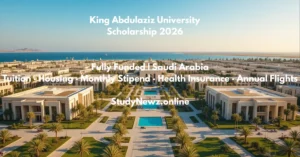
The majority of students who miss out on scholarships like this one don’t do so because they were not eligible. They lose out because no one informed them of the true requirements of the application, including specifics on documents, dates, SOPs, and life after arriving in Jeddah.
That is fixed by this guide. One of the few completely financed programs in the world that accepts students from all nations without requiring you to pay a single riyal is the King Abdulaziz University Scholarship 2026. No fees. No rent. No medical expenses. It’s just you and your education and a monthly stipend to get by.
Read this through to the end if you are considering applying or simply thinking about if you are eligible. You won’t have to spend weeks conducting disorganized research or make several blunders that could destroy your application.
King Abdulaziz University – The Institution Behind This Scholarship
Knowing the name of a university is not the same as truly comprehending its nature. You should see the true picture of KAU before devoting months to an application.
In 1967, King Abdulaziz University began as a small, private school in Jeddah. It was taken over by the Saudi government seven years later in 1974 and converted into a public research university. It is now ranked #134 in the QS World University Rankings 2026 which is quite excellent. and places it above several universities that students in Southeast Asia, Africa, and South Asia would consider “top tier.”
Jeddah itself matters here. It is the principal commercial port of Saudi Arabia and has a distinct personality from Riyadh because it was founded on trade for centuries. Compared to inland cities, it feels less constrictive has a more diverse population and is situated beside the Red Sea. Jeddah is often regarded as one of the more friendly Saudi towns for foreign students coming from countries like Pakistan, Nigeria, or Indonesia.
Each of the university’s two distinct campuses is one for male students and one for female students. has its own labs, library, sports facilities, cafeteria, prayer halls, and areas for student activities. Neither is more important than the other. Both are fully equipped. Faculty members come from all over the world, and the student-to-faculty ratio is kept low enough that you actually receive academic guidance rather than just sitting in a hall with 300 other people.
| University | King Abdulaziz University (KAU) |
| Location | Jeddah, Saudi Arabia |
| QS Ranking 2026 | #134 Globally |
| Founded | 1967 |
| Scholarship Funder | Saudi Ministry of Education |
| Degree Levels | Bachelor’s, Master’s, PhD |
| Open To | All non-Saudi international students |
| Gender Policy | Both male and female students |
| Teaching Language | English (Arabic for select programs) |
| How to Apply | Online — kau.edu.sa or Study in Saudi portal |
What Is Actually Covered by This Scholarship
The term “fully funded” is used confusingly by many schemes. Some pay for housing but not tuition. Some do not cover flights, but they do cover housing. Some provide you with a meager stipend that hardly covers eating. That is not the case with the KAU fully funded scholarship for 2026. Here is an honest breakdown of each benefit.
Your tuition has completely disappeared.
Your tuition is paid directly by the institution from the start of your program until the end of it. There are no registration fees, semester fees, or additional academic expenses. Depending on their degree, self-funded students at Saudi universities usually pay between 12,000 and 40,000 riyals annually on tuition alone. None of that will be paid by you.
A Monthly Amount That Really Arrives in Your Account
The institution credits your account with a monetary stipend each month. You receive the money on a regular basis and are free to spend it anyway you see fit. And this is not a refund system where you pay initially and claim later.
| Your Degree | Monthly Allowance |
| Bachelor’s | SAR 850 — roughly $226 or PKR 63,000 |
| Master’s | SAR 900 — roughly $240 or PKR 67,000 |
| PhD | SAR 1,900 — roughly $506 or PKR 1,41,000 |
In Jeddah, the average monthly cost of groceries for an individual is between 400 and 700 riyals. An additional 120 to 200 riyals are spent on local transportation. This monthly sum serves mostly as personal spending money rather than survival money because your housing and health insurance are already covered.


Free Housing — Arranged Before You Land
The university provides on-campus housing for scholarship recipients. You don’t look for an apartment. You do not negotiate with a landlord in a city you do not know yet. There is no deposit required. The internet is available the room is furnished and you can walk or take a quick shuttle from your academic buildings.
Shared rooms are a feature of on-campus housing. you will probably share a room with another international student. Study areas, prayer facilities, and cafeteria access are all a part of the same campus community.
The Health Insurance You Really Need
Medical emergencies abroad, without coverage, can wipe out years of savings. KAU scholarship students are covered by full health insurance for the duration of their program. Emergency care, hospital stays, doctor visits, and prescription medications are all paid for out of pocket.
A Return Flight Home Every Year
The university purchases a round-trip airfare between Saudi Arabia and your home nation once every academic year. This alone saves hundreds of dollars a year for students from sub-Saharan Africa, Pakistan, and India. More significantly it keeps you in touch with your family in person rather than just on a screen.
Allowance for Two Months on the Day of Arrival
The university provides you with a one-time preparation allowance equal to two full months of your stipend when you initially arrive in Saudi Arabia prior to the start of your regular monthly payments. This eliminates the need to use money you brought from home for the first purchases you need to make such as toiletries or a local SIM card and your first food.
Subsidized Meals on Campus
Scholarship students pay significantly lower prices at campus cafeterias. The daily expenses of attending KAU are actually little when you take into account the monthly allowance, free lodging, and subsidized food.
Research Resources and Thesis Support
One of the biggest academic libraries in the Arab world is KAU’s core library. Every scholarship recipient has complete access to academic archives, research databases, digital journals, and physical books. The scholarship also pays for the cost of printing and binding your thesis for Master’s and PhD candidates, as well as a separate stipend for sending your books and course materials home after graduation.
Campus Work for Postgraduate Students
The university may provide research assistant roles to some Master’s and PhD students especially those enrolled in research-intensive programs. These exist and offer both extra money and worthwhile academic experience however they are not guaranteed for everyone.
Emergency Support When Life Gets Difficult
For scholarship recipients who encounter unforeseen circumstances, such as a family emergency, an unexpected illness, or an unplanned expense, KAU offers an official emergency financial aid fund. Although you won’t learn about it at orientation but students have actually utilized it.
KAU vs. Other Saudi University Scholarships
If you are weighing the KAU scholarship for international students against other Saudi options, here is a straightforward comparison so you can make a decision based on facts rather than assumptions.
| KAU | King Saud University | KFUPM | |
| QS World Rank 2026 | #134 | Top 300 | #67 |
| Tuition | Free | Free | Free |
| Monthly Stipend | SAR 850–1,900 | SAR 850–1,900 | Higher (STEM-weighted) |
| Housing | Free | Free | Free |
| Health Insurance | Yes | Yes | Yes |
| Annual Return Flight | Yes | Yes | Yes |
| Fields Available | All disciplines | All disciplines | Engineering and Sciences only |
| City | Jeddah (coastal, cosmopolitan) | Riyadh (capital city) | Dhahran (industrial city) |
| Teaching Language | English and Arabic | English and Arabic | Primarily English |
| Competition | High | High | Very high |
The truth is that KFUPM has an excellent track record in subjects like petroleum engineering and specialized STEM research if you have a strong academic record. However, KAU offers a wider range of programs a more pleasant coastal city and a similarly good scholarship package for the majority of international students, particularly those in business, humanities, Islamic studies, computing, or general sciences. For the majority of people it is the best option.
Programs You Can Apply For
The KAU scholarship 2026 covers degrees across eight faculties. Here is what is available:
Sciences — Mathematics, Statistics, Physics, Chemistry, Biology, Geology, Biochemistry
Engineering — Civil, Electrical, Mechanical, Chemical, Architectural, Environmental, Nuclear Engineering
Computing and IT — Computer Science, Information Systems, Information Technology, Software Engineering, Cybersecurity
Business and Economics — Business Administration, Accounting, Finance, Economics, Marketing, International Business
Humanities and Social Sciences — Psychology, Sociology, Geography, History, Library and Information Science
Arts and Languages — Arabic Language and Literature, English Language and Literature
Islamic Studies — Islamic Studies, Sharia and Islamic Law, Quran and Tafsir
Health Sciences — Public Health, Nursing, Pharmacy, Applied Medical Sciences, Clinical Nutrition
Program durations: four years for a bachelor’s degree, two years for a master’s degree, and three to four years for a doctorate, depending on the state of the study.
To be clear, scientific, engineering, computer, and business subjects are taught in English. Arabic is used to teach programs in Islamic Studies, Arabic Language, and the majority of Sharia related subjects. Your Arabic must be proficient enough to study in an Arabic medium program not only conversational.
Eligibility — Do You Qualify?
Take your time going over this section. Many students assume they qualify and then discover a problem only after they have spent weeks collecting documents. Before continuing check each point for your particular degree level.
If You Are Applying for a Bachelor’s Degree:
A secondary school certificate, such as an FSc, A-Levels, matric with intermediate or another equivalent qualification accepted in your nation. You are eligible if you completed your education in 2022 or later because the certificate cannot have been granted more than three years prior to your application. When you apply must be between the ages of 17 and 25. A medical fitness certificate or a spotless conduct record and no history of expulsion from any Saudi university are required.
Academic grades are not graded on a strict percentage in many cases for undergraduate students. But weak grades will still hurt your chances. Strong secondary results matter.
If You Are Applying for a Master’s Degree:
Your academic status must be at least “Very Good” (a GPA of 3.0 out of 4.0 or its equivalent in your country’s grading system) and your bachelor’s degree must be from an authorized university. You have to be younger than thirty. Two recommendation letters, not from employers or personal relationships are required from instructors at your prior university. If your degree was not in English you must provide confirmation of your English language proficiency. No Saudi institution could have fired you.
If You’re Making a PhD Application:
A Master’s degree with a minimum grade of “Very Good” from an accredited university is required. You have to be younger than 35. It is necessary to have two academic recommendation letters especially from instructors who have worked with your research rather than merely those who know you in the classroom. It will be expected that there will be a research proposal or statement of research intent. Proof of English proficiency is required if applicable. No history of Saudi dismissal.
English Language — What Score Do You Need?
| Test | Score You Need |
| IELTS Academic | 5.0 |
| TOEFL PBT | 500 |
| TOEFL CBT | 173 |
| TOEFL iBT | 61 |
The results of your exam must be from the last two years. Anything older than that will not be accepted, regardless of how high the score is.
Many students are unaware that you can ask your university’s registrar for a Medium of Instruction letter if your Bachelor’s or Master’s degree was exclusively taught in English. You may be completely excluded from submitting an IELTS or TOEFL score if you provide this letter attesting to the fact that your program was taught in English. Before registering for a language test it is worthwhile to inquire about this with your registrar.
If you are also exploring fully funded options beyond Saudi Arabia then the Fulbright Scholarship 2026 is one of the most prestigious programs available to Pakistani students. For study in the United States — worth reading about before you finalize your decision.
Documents You Will Need — The Complete List
More KAU scholarship rejections are caused by document issues than by any other single factor. Incomplete or uncertified paperwork is not a sign of poor academic performance or poor SOPs. Take careful note of this section.
Each document you submit must fulfill three requirements: it must be in English or Arabic, or include a certified translation if it is in a different language. It must be a certified true copy or the original. and it must include the certification stamp of the Saudi Embassy in your home country.
Every document you require is available here:
- Your passport must be valid for a minimum of 12 months from the application date. Before you do anything else have yours renewed if it expires in less than a year.
- The certificate of your degree. The real certificate for your greatest degree not a scan without an official stamp or a printed copy from a portal. For certification, this certificate must be sent to the Saudi Embassy. It won’t be approved without that embassy stamp.
- Official academic transcripts that display all grades semester by semester and year by year. Certification from the Saudi Embassy is also required. Transcripts from your university should be kept sealed until they arrive at the embassy.
- A pair of letters of recommendation: Two distinct letters from two different instructors at your former school. Every letter needs to be on official university letterhead. And have the department or institution seal stamped on it and be signed by the professor. A letter from your employer, your department head who you never took a class with, or a family friend who happens to be a teacher does not meet this requirement.
Most students underestimate how much a recommendation letter can make or break their application. If you are not sure how to approach your professor or what the letter should include. Our guide on how to get a recommendation letter for a scholarship walks you through the entire process in plain language.
- Statement of Purpose Written in English for all programs except those taught in Arabic. This is your argument for why you deserve a place in this program. It needs to be specific, honest, and not borrowed from any template or generated with any tool. There is a full writing guide for this later in the article.
- Your CV: A current CV that highlights your schooling, employment or research experience, academic accomplishments, and publications if you have any relevant experience. Unless your research record really needs additional material keep it concise or straightforward and under two pages.
- If your prior degree was not in English you must have an English Language Test Certificate (IELTS or TOEFL) dated within the last two years. If you believe you are eligible for the exemption bring the Medium of Instruction letter from your registrar.
- Certificate of Medical Fitness from a qualified physician or a recognized medical authority in your nation of origin. This attests to your physical fitness for studying overseas.
- Certificate of Good Conduct issued by a civil authority in your native country or by your former university. In many nations, a police clearance is acceptable. This attests to the fact that you have no significant criminal or disciplinary history.
- Passport-Sized Photos according to the guidelines on the online application portal. Before printing anything make sure the size and format are correct by checking the gateway.
Extra Materials for PhD Candidates: a one to two-page research proposal outlining the field you plan to study for your doctorate. If you have any published papers or conference presentations please list them. A clear and well-considered study proposal becomes even more crucial if you don’t have any but it doesn’t automatically disqualify you.
How to Write an SOP That Actually Gets Read
Most students write the Statement of Purpose last and with the least attention. That is not correct. An admissions reviewer who has read 200 identical generic SOPs will notice immediately when one is different . when it sounds like a real person with a real reason for being there.
Here is the working framework explained simply:
- Be honest about your academic identity rather than your personal narrative. The reader should be immediately focused by your opening paragraph. What were you studying? Where? By the time you were done, what were you interested in or working on? Don’t tell the tale of your early inspiration. Focus on how your academic background relates to this application.
- Make the case for this particular program. One point needs to be addressed in your second paragraph: why this field, and why now? What knowledge or professional gap will this Master’s or PhD cover for you? “I want to deepen my understanding of structural engineering because my undergraduate thesis on load distribution left several questions unresolved” is a better phrase than “I have always been passionate about engineering.”
- Describe why KAU in particular. Most SOPs fall short in this situation. The reviewer knows that KAU is a “world-renowned institution” and has read that statement hundreds of times therefore it doesn’t inform them anything. Check out the faculty pages at KAU. Look for a professor whose published work relates to your area of interest. Give them names. Name one particular KAU research center or project that supports your objectives. This takes one hour of research and it makes your SOP stand apart from every generic application in the pile.
- Tell them what you plan to do with this degree. A scholarship reviewer is investing in your future on behalf of the Saudi government. They are looking for evidence that you have considered beyond graduation. Will you return to your country and enter a specific sector? Are you planning a career in research? Do you intend to teach? Be honest and be specific. If you genuinely have not decided, then say what your two most likely paths are and why both of them require this degree.
- Close with confidence, not flattery. End with a clear statement of your commitment and a genuine expression of interest — not a paragraph of praise for how wonderful KAU is. Two or three sentences is enough. End it feeling like a person who knows what they want and has made a considered decision to apply here.
- Length: 500 to 700 words is the right range. Shorter than 500 feels thin. Longer than 700 risks losing the reviewer’s attention in a way that hurts rather than helps.
- The four things that kill an SOP: Copying any part of it from a template or another source. Exaggerating achievements you cannot document. Writing it the night before the deadline when your thinking is not clear. Using the same SOP you wrote for a different university without adjusting it for KAU specifically.
Writing a strong SOP takes more than good intentions. If you want a step-by-step breakdown of exactly what works and what silently kills most applications. Read our complete guide on how to write a winning SOP for scholarship before you start drafting yours.
Application Deadlines
| Degree | Deadline |
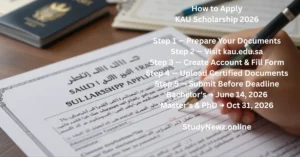
| Bachelor’s Programs | June 14, 2026 |
| Master’s and PhD | October 31, 2026 |
Postgraduate program deadlines in October seem far away from where you are at the moment. It isn’t. In most locations, Saudi Embassy document verification takes two to six weeks. making sure you schedule your appointment as soon as possible. An additional six to eight weeks are needed for IELTS preparation and scheduling if necessary. An additional two weeks are added when a professor takes two weeks to reply to your request for a recommendation letter. The deadline tends to come sooner rather than later. so go to work on it today.
Applying — What You Actually Do, Step by Step
Prepare your documents before using the portal. The most frequent error made by students is to access the application portal and begin filling it out. and then discover that their IELTS score has not yet been uploaded or that one professor has not yet sent the recommendation letter. Before you log in make sure everything is physically prepared.
Locate the portal and register for an account. Locate the foreign admissions or scholarship area at kau.edu.sa. As an alternative, look for the government portal for studying in Saudi Arabia. To access the Study in Saudi portal some countries require a VPN. Chrome and Firefox typically perform better than other browsers in this regard.
Create an account with an email address that you check every single day. Status updates, requests for additional documents, and ultimately your acceptance or rejection will come through that address. Using a shared family email or an address you check once a week is a risk you do not want to take.
Fill in the form with zero shortcuts. Every section of the application form asks for accurate information. Your academic history, personal details, contact information, and program selection all need to match your actual documents exactly. If your transcript spells your name one way and your passport spells it differently, fix that before you apply — even a name discrepancy can hold up your application.
Make strategic program selections. Select the field that most closely aligns with your educational background. Applying for a Master’s degree in computer science or information technology makes reasonable and will be simple to defend in your SOP if you studied computer science as an undergraduate. Applying to a school that has nothing to do with your academic background causes a difficulty in your SOP that is very difficult to justify.
Upload documents cleanly. Scan every document with a proper scanner if you can — phone photos are often blurry at the edges and the embassy stamp may not be readable. Make sure every scan is complete, not cropped, and meets the file size and format requirements listed on the portal.
Submit, then save your confirmation. After submitting, take a screenshot or save the confirmation email immediately. Your application reference number is important if you ever need to contact KAU’s admissions office.
Check the portal regularly after submission. Log in every week or two. The admissions team won’t always send an urgent email if they need an interview, an extra document, or clarification. Sometimes a delayed reaction from your end is recorded as a withdrawal.

Living in Jeddah as a Scholarship Student — The Honest Version
Most scholarship guides describe student life in exactly two sentences and then move on. That is not helpful when you are making a decision about living in a country you may never have visited. Here is the real picture.
Jeddah as a City
Almost four million people live in Jeddah. Saudi Arabia’s primary Red Sea port and economic center it has always had a more diverse population than Riyadh. You may discover architecture and culture. that are truly different from the rest of the Gulf when you travel through ancient districts like Al-Balad or a UNESCO World Heritage site. Shopping malls a variety of eateries and an expanding entertainment industry. and a lengthy shoreline along the Red Sea Corniche where people congregate and work out in the evenings are all features of the city.
Jeddah is often a pleasant surprise when compared to what most foreign students envision Saudi Arabia to look like.
Life Inside the KAU Campus
The campus is a self-contained setting. The campus contains your academic buildings, library, sports courts, swimming pool, gym, cafeteria, prayer halls, and student club areas. In the initial weeks the school itself offers nearly all the necessities for overseas scholarship recipients as they progressively establish themselves in the larger city.
There are people from dozens of different nations within the KAU student body. you won’t be the only international student or the only person traveling for the first time.
Things You Need to Know Before You Arrive
Saudi Arabia truly differs from the majority of other nations in that it is governed by Islamic law and social standards. These are institutional and legal requirements rather than recommendations:
- In Saudi Arabia alcohol is strictly prohibited. There are no private allowances, duty-free amounts, or exceptions. This isn’t limited to public areas it applies to the entire nation.
- Both men and women should dress modestly in public. For women, this means covering hair and wearing loose clothing outside of campus. Although each building on campus has its own set of rules but dressing conservatively is usually a good idea.
- Saudi Arabia has five times a day for prayer. Many stores and services take a temporary break at these times especially during midday and afternoon prayers.
- Even non Muslim residents and students were banned from eating or drinking or smoking in public during the daytime hours of Ramadan. Cafeterias on campus modify their hours accordingly.
- Although they attend the same university but male and female students have different campuses and academic areas. This holds true for all Saudi universities.
- Scholarship-eligible international students are not allowed to work outside of the university while they are enrolled.
What Your Monthly Stipend Covers in Practice
| What You Spend On | Estimated Monthly Cost |
| Groceries | SAR 400 – 700 |
| Local transport | SAR 120 – 200 |
| Personal care | SAR 100 – 150 |
| Phone and internet | SAR 80 – 120 |
| Clothing and extras | SAR 100 – 200 |
| Total estimate | SAR 800 – 1,370 |
With free housing, health insurance, and subsidized meals already removed from your equation, a PhD student receiving SAR 1,900 per month typically has money left over each month. Even Master’s students receiving SAR 900 generally find their stipend workable given how much is already covered.
Learning Arabic — Worth Starting Before You Arrive
English will be used in your academic classes. However, Arabic is spoken throughout Jeddah’s streets, stores, taxis, and pharmacies. Your everyday experience is significantly altered if you learn even 80 to 100 common phrases before you come. Take advantage of the Arabic language classes that KAU itself offers to overseas students prior to the start of academic programs. You will have a significant advantage if you spend two hours a week on a free language app in the months before your departure.
After You Graduate — Where Does a KAU Degree Take You?
This is a question that deserves a real answer rather than a vague line about “global career opportunities.”
- The employment market in Saudi Arabia is expanding rapidly. Significant investments have been made in technology and healthcare. Entertainment or finance, and infrastructure as a result of the government’s Vision 2030 plan. These industries are all in need of KAU graduates with suitable degrees. A degree from a Saudi university combined with on-the-ground Saudi experience and at least functional Arabic is a genuine career advantage in this market.
- Saudi government university degrees are respected across the larger Gulf region. it includes the United Arab Emirates, Qatar, Kuwait, Bahrain, and Oman. Numerous KAU graduates have found employment in Gulf-based businesses or governmental organizations and multinational corporations that operate throughout the Gulf Cooperation Council.
- Continuing your studies is a well-traveled path from KAU. A Master’s degree from a QS #134 university is a strong credential when applying to PhD programs in the UK, US, Canada, Australia, or Germany. Admissions offices at well-known universities recognize KAU, and KAU’s faculty networks often extend internationally in ways that help with recommendations and connections.
Problems You Might Face And How to Handle Them
Your IELTS score does not exist yet and the deadline feels close. There is still time if the deadline is five months or more away. That timeframe can handle six weeks of concentrated study or scheduling an exam and waiting for the results. Instead, apply for the Medium of Instruction exemption if your prior degree was taught in English. Get in touch with your university’s registrar and get a letter verifying the language of instruction. This method saves time and money.
The Saudi Embassy is far and certification takes weeks. Book your embassy appointment the day you decide to apply.Appointment slots fill up weeks in advance in several places. Plan for the entire certification process to take four to six weeks and treat that as your actual personal deadline, not October 31.
One of your professors is not responding to the recommendation letter request. Send a clear, polite email that includes your CV, your draft SOP, the program you are applying to, and the specific deadline for the letter. Wait seven to ten days. If there is still no response then send one follow-up. If that also gets no reply then move on and ask a different professor — submitting without a letter is far worse than submitting with one from someone who responds.
You are unsure which program to apply for. You’re not sure which program to apply for. Return to your undergraduate or graduate degree and honestly ask yourself, “Which KAU program is the most logical extension of what I have already studied?” Apply for that one. When your academic background and program choice make sense, then you write the sop and the application will be more trustworthy and your chances of being chosen are increased.
You submitted a few weeks ago, but you haven’t heard anything. The processing of postgraduate applications can take several months. This is not unusual and it does not mean something went wrong. Regularly check the status updates on your application portal by logging in. If 60 days have passed since the deadline closed and you still see no movement, a polite, brief email to the KAU international admissions office asking for an update is acceptable.
Questions Students Ask Most Often
Does “fully funded” really mean no fees at all?
Yes. Tuition is covered, housing is provided, health insurance is included, and the monthly stipend is paid without deduction. The application itself costs nothing. There are no enrollment fees, registration deposits, or administrative charges.
Students from Pakistan, India, Nigeria — can we all apply?
Yes, all of you. The KAU scholarship for international students has no nationality quotas and no geographic restrictions. The program is open to students from every country in the world that is not Saudi Arabia.
How difficult is it to get selected?
The program is competitive, but the difficulty varies by field. Computer science and engineering tend to attract the largest number of applications. Some humanities and social science programs are somewhat less contested.
Is the housing shared?
Yes. On-campus scholarship accommodation is typically a shared room with one other student, usually another international student. Private rooms are not standard for scholarship students.
12 Things That Separate Strong Applications from Weak Ones
- It is nearly never sufficient to begin work on documents one month prior to the deadline. In most locations, Saudi embassy certification takes four to six weeks and certain embassies are fully booked. A minimum of three months provides you with a large margin.
- Letters of recommendation from professors who are able to discuss your academic work in detail are significantly more valuable than letters from persons who hardly know you but have great titles. Your thesis supervisor’s brief, personal, and targeted letter is more effective than a lengthy, formal letter from your department chair, with whom you have never had contact.
- You must be the exclusive source of your SOP. Hundreds of these were read by reviewers. A letter that sounds pieced together from other documents, too professional, or suspiciously polished can be seen as inauthentic, and inauthentic SOPs usually don’t make it through the selection process.
- If your passport is valid for at least 18 months , not the minimum 12. you will have more time to deal with the initial paperwork of establishing residency in Saudi Arabia as well as any delays in the processing of your visa.
- Schedule the IELTS exam at least three months prior to the scholarship deadline if it is necessary. exam facilities load up and results are usually available two weeks after the exam. so waiting this long is a risk that may be prevented.
- Apply to a program that your academic background can support in an SOP. A computer science graduate applying for Islamic Law has a nearly impossible SOP to write convincingly. Make it easy for reviewers to say yes.
- Every document needs the Saudi Embassy stamp. This is not a formality that gets waived. Every rejected document that needs to go back to the embassy costs you two to four more weeks.
- Make sure your email address is both personal and professional and using your entire name or something similar. Reviewers do communicate with candidates via email and the address they write to provides information about the recipient.
- Every document you upload both digital and physical. You should be kept in full copy. You want it ready in a matter of hours rather than days if the site has a technical problem or requests that you submit something again.
- Agents who charge a fee to process your KAU application are not affiliated with the institution. You can apply straight through the official webpage and it is free. Paying someone to submit on your behalf introduces a risk-taking middleman with no authority.
- Before you arrive, start learning Arabic. Even using a phone app and two hours a week will help you acquire enough vocabulary to significantly improve your everyday life once you get there. As soon as you are accepted enroll in one of KAU’s pre-program Arabic courses.
- If you can, apply in your final year of school while you are still enrolled. Your grades are up to date or your instructors are aware of your latest work, and the application shows your academic progress. It takes more work to explain what you have been up to when you apply years after graduation.
How to Apply
Applications are submitted online only. Two official routes:
Go to kau.edu.sa, find the international admissions section, and follow the scholarship application link. Alternatively, access the Saudi government’s Study in Saudi Arabia portal and find King Abdulaziz University in the institution listings. Both paths lead to the same application system.
Do not apply through any third-party website, scholarship aggregator, or agent portal. The only valid application is the one submitted directly through KAU’s or Saudi Arabia’s official channels.
One Last Thing Before You Close This King Abdulaziz University Scholarship Page
There are no financial requirements for the King Abdulaziz University Scholarship 2026. It doesn’t require you to go on debt in order to sacrifice your academic future. It requires you to take the time to produce a proper application or complete with appropriate documentation or an honest SOP and genuine recommendation letters. and to fulfill the fundamental requirements for eligibility stipulated by any reputable academic program.
What it gives you in return is your entire degree, your housing, your health coverage, regular flights home, and a monthly allowance to live on. From an institution ranked in the global top 150. In a city that is more livable than most people expect.
Students who approach this with the same seriousness they would bring to a job interview — not casual, not rushed, not copied from somewhere else — have a genuine chance at being selected.
Start today. Not next week.
StudyNewz.online is Pakistan’s scholarship news and guides platform. Bookmark this page and share it with a student who needs it.
Read more: https://studynewz.online/hec-talent-hunt/